
Building Healthy Communities
An evidence-based toolkit founded on UC Davis research to advance equitable, inclusive, healthy, and sustainable communities
Researchers across the University of California, Davis campus are pursuing cutting-edge research to understand how communities can be supported to meet the needs of aging and diverse populations, while emphasizing equity, inclusion, health, and sustainability. The Building Healthy Communities Toolkit is a single repository for UC Davis discoveries and expert guidance on community planning, drawing on expertise from across the University’s 11 schools and colleges.
With the power of Artificial Intelligence (AI) and Large Language Models (LLMs), the toolkit offers a single, multi-disciplinary database that can be explored and analyzed to offer up-to-date, comprehensive recommendations on any number of questions and issues related to building healthy communities for the future.

UC Davis expertise in community design can be found across campus, including in these six central pillars:
Development – Equity – Health – Housing – Sustainability – Transportation
Our approach: The Building Healthy Communities Toolkit was developed from recent UC Davis publications related to each of the central pillars described above. Expert guidance, recommendations, and other significant conclusions relevant to policymakers and community developers were compiled into a central dataset.
The Toolkit dataset currently contains nearly 400 evidence-based recommendations. See the figure at right for a breakdown of recommendation topics.
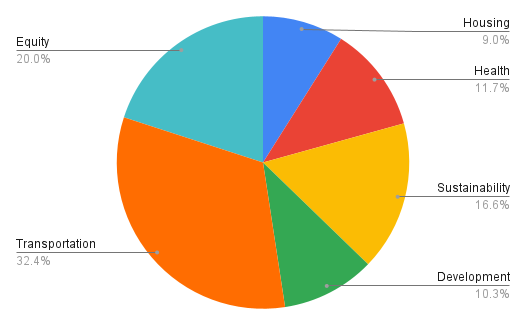
Dataset summary generated by ChatGPT 5
Key considerations for planning
1. Create transportation access that works for everyone
- Universal access to mobility is essential, including affordable and low-barrier travel options, and requires investment in charging infrastructure, pavement design, and safe roads
- People without cars, with disabilities, or in underserved neighborhoods benefit from reliable and shared mobility; With accessible transportation, older community members can remain socially connected and meet daily needs, key determinants of healthy aging.
2. Follow evidence-based policy and infrastructure planning
- Consider full life-cycle impacts of infrastructure, beyond construction, and avoid expansions that increase emissions and follow good management and maintenance practices for infrastructure
- Understand where investments will improve access and equity rather than reinforce existing disparities
3. Make safety a core design requirement
- Prioritize safety in system design, especially in underserved areas that often face highest safety risks, and invest in safer walking and bicycling infrastructure to encourage lower-pollution travel choices
- Design communities for reduced emissions and increased shade to reduce health risks to vulnerable populations, like the elderly
4. Invest in technological and infrastructure readiness
- Build infrastructure that supports long-term community needs
- Ensure new technologies are affordable and accessible to more than the wealthy early adopters
Key trade-offs in community design
1. Expanding transportation access versus environmental cost
- Improving mobility may lead to induced travel and increased carbon emissions
- Sustainable strategies must avoid solving access problems in ways that worsen climate impacts
2. Electric Vehicle (EV) infrastructure versus equity
- Charging networks benefit those who can buy EVs or charge at home
- Without policy design, clean-transport investments can reinforce inequality
- Shared mobility and university basic mobility can balance this trade-off
3. Safety improvements versus cost and space
- Safer, more bike- and pedestrian-friendly streets may require reallocating street space or imposing regulations that conflict with car-first planning
- Pedestrian-friendly street designs can benefit populations that are unable to drive, such as the elderly and those with disabilities, but may experience pushback from car-dependent groups
- There are cost and political trade-offs in redesigning infrastructure
4. Long-term sustainability versus short-term convenience
- Pavement durability and management techniques improve environmental outcomes, but require upfront resources and maintenance planning
- Communities must balance immediate travel efficiency with lasting resilience
How did we generate this summary?
The Toolkit dataset can be explored and synthesized with the help of AI tools to identify important intersections, trade-offs, and underlying themes relevant to develop communities that emphasize equity, inclusion, health, and sustainability. To demonstrate this capability, we uploaded the Toolkit dataset into ChatGPT 5 with the following prompt:
Using information from the attached file, what are key considerations for planning a community that advances inclusiveness, equity, and sustainability for its residents? What are important trade-offs in these considerations?
This dataset was compiled by the Grand Challenges team, including support from undergraduate student, Kyle Naranjo.
Who produces these recommendations?
The Toolkit includes full citations to the referenced literature produced by UC Davis researchers. Examples of UC Davis groups responsible for creating this information include: